Filing a Foia Lawsuit Agains the City of Chicago
The Community Commission for Public Safety and Accountability (CCPSA), a civilian police oversight trunk established past Metropolis ordinance in 2021 that is set to ramp up later this year, will have legal powers to request information about police activities from the Civilian Office of Police Accountability (COPA) and the Chicago Police force Department (CPD). Such requests will be similar to those the public and journalists can brand through the Illinois Freedom of Information Act (FOIA), which allows anyone to ask public agencies for data and documents.
But FOIA requests in Chicago often sew together against denials of varying legality. The CCPSA may find its requests similarly held upwardly past one of the City'due south most abused reasons for denying the public access to information: if the committee requests records tied to an ongoing investigation, the Urban center can deny access to those records.
While it's difficult to predict whether the City will deny the commission access to information, its history of withholding data in consistent violation of the police force may be the public's clearest view into how CPD will respond to the Committee'southward requests for information.
The CPD is by no means shy in denying the public access to information near its operations, and often cites ongoing investigations in doing so—often with dubious reasons and scandalous outcomes. In 2019, Anjanette Immature submitted a FOIA asking for footage from body-worn cameras (BWC) of the police officers who wrongfully raided her home earlier that twelvemonth. The law department's FOIA office denied Immature's request because an investigation of the raid was ongoing.
Young ultimately filed a lawsuit to compel the department to comply with her FOIA request.
To understand whether the denial of Young's request'due south was a rare i-off, or one that typifies the Chicago police department's approach to FOIA requests, the Weekly pored over hundreds of FOIA requests that the CPD denied based on legal rationalizations like to those cited by the department when it denied Young's.
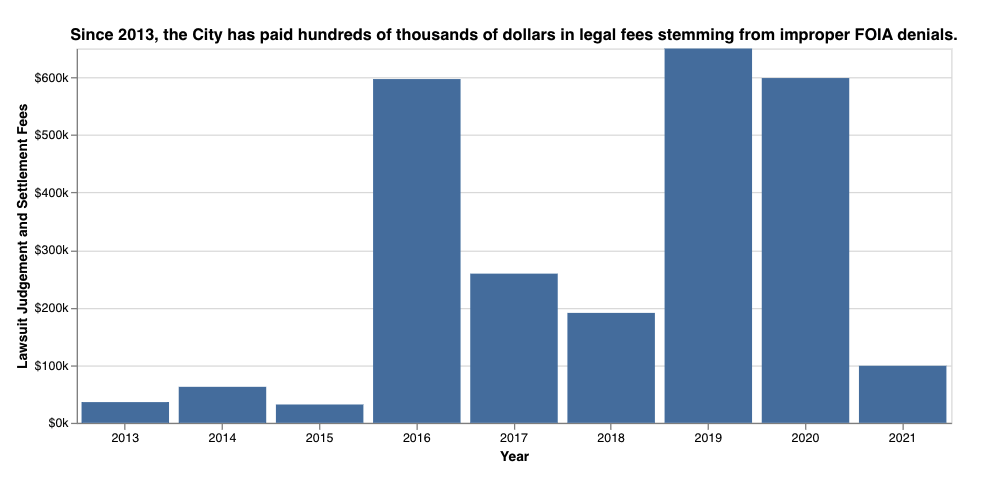
This research adds to an ever-growing torso of reporting and litigation surrounding the City's flagrant condone for the transparency mandates it's required past law to follow.
The Illinois FOIA allows certain records to be exempt from disclosure, and describes such exemptions in section 7(i) of the law. Some examples include: private personal information in department 7(one)(b), documents related to ongoing investigations in section vii(1)(d), and administrative proceedings in department 7(1)(n).
I reviewed 350 FOIA requests that were denied by CPD under 7(1)(d), the portion of the Illinois FOIA that deals with ongoing investigations, betwixt January 1, 2020 and March 31, 2021.
When I submitted a asking for all such denial messages, the department initially argued that identifying requests denied under seven(ane)(d) would be unduly burdensome, meaning it would overwhelm their part with the work required to fulfill information technology.
I reason that the request was considered "burdensome" stemmed from a limitation in the police department's FOIA tracking software that but immune the recording of one denial reason, while requests are frequently being denied with multiple exemptions. The only manner for CPD to find all requests denied under seven(1)(d) was to review all denial letters sent during the timeframe on the hazard that seven(1)(d) was used in addition to the exemption recorded by CPD in their tracking software.
To hogtie CPD to go along track of all exemptions for all requests going forward, I am currently suing CPD , arguing that CPD is in violation of FOIA by not making an index of exemptions used in requests public, as required by the law.
Since the first of the lawsuit, CPD has updated their software to allow it to track more than one exemption per request.
The problem seems mutual; I requested a log of all FOIA requests and an alphabetize of exemptions from all thirty-six agencies listed on Chicago'south FOIA contacts page , and just vii agencies shared the exemptions they used .
✶ ✶ ✶ ✶
The analysis in this article covers the time periods between 2020 and early-mid 2021.

Four months later on the asking was submitted, CPD completed the request and provided 286 requests. To cover the time periods after Mayor Lori Lightfoot promised to make it easier to request BWC footage, in October 2021 I requested all requests denied under Section vii(ane)(d). CPD again argued that it would be unduly crushing to release that many documents and we agreed to narrow the request down to January 1, 2021 through April 1, 2021. Once we provided the narrowed asking, CPD completed it in under a week.
Through ane of the most common reasons for denying FOIA requests, an agency can deny admission to records every bit "unduly burdensome" if completing the request is so time consuming that it prevents the Metropolis from doing its day-to-day piece of work. The common exemption has its limitations to forbid its abuse past authorities agencies, including losing access to the exemption if the Metropolis doesn't answer within five days—as happened with Charles Green'southward FOIA request that led to the release of tens of thousands of misconduct investigations .
Additionally, the constabulary prohibits the City from claiming an unduly crushing exemption in cases where in that location is "overwhelming public interest" in the records that outweighs the toll to the City of reviewing them. The law also requires the Metropolis to provide "articulate and convincing testify" supporting whatsoever exclamation of the contrary.
CPD showed a deep disregard of the public's interest and press access to data for two 2020 police shootings that sparked major protests beyond the city. Despite the unmistakable public interest in both police shootings, CPD denied all requests for torso-worn camera (BWC) footage of them, arguing that reviewing the footage in preparation of releasing it would be disproportionately burdensome. The news organizations that were denied the footage included The Chicago Reporter , CBS ii , the Lord's day-Times , WBEZ , ABC vii , WGN-Television receiver , Chicago One Media , and NBC 5 .
Merrick Wayne, an attorney at Loevy & Loevy, has litigated many FOIA lawsuits against CPD, including my own. He says CPD hasn't followed the constabulary when it used the "unduly burdensome" clause to deny these requests because the section didn't estimate how long the review would have and didn't bear witness how the cost of reviewing them would outweigh the public interest in seeing them. Wayne adds that by non providing opportunities to narrow the scope of such requests, CPD waived the legal use of the unduly burdensome exemption. In their denials, CPD argued there was no mode to narrow those requests, only failed to say how.
During my investigation with Matt Harvey for the TRiiBE , of one of the two shootings, CPD as well denied a request for logs from ShotSpotter devices , citing ongoing investigations. Despite its denial, ii months prior to the TRiiBE's asking to CPD for ShotSpotter logs, COPA released videos that contained the same information CPD had denied—audio of the shooting from multiple cameras in the area.
The TriiBE escalated the request to the Illinois Public Access Counselor (PAC), which hears authoritative appeals of FOIA denials. CPD responded several weeks afterwards with ShotSpotter logs, over 3 months after the request was submitted. The document provided describes fewer recorded shots than what police officers claimed in reports they filed.
Nonetheless, fifty-fifty though COPA released the video from that police shooting, the City continues to fight a lawsuit that was filed in September 2020 seeking the same footage. Attorneys for CPD filed an entreatment in July 2021 that claimed the department is not obligated to release the footage. If a regime bureau denies a request, it has the legal obligation to provide articulate and convincing evidence that the information it'southward withholding is exempt from disclosure.
This is made clear in the PAC'due south FOIA Guide for Law Enforcement , which notes that nether FOIA, all records an bureau holds are presumed to be open to inspection, and whatever assertion that a record is exempt from disclosure must include "clear and convincing evidence" that that record is in fact exempt.
The PAC's Guide goes on to say, "Perhaps the near common error the PAC encounters in reviewing FOIA denials is the failure of public bodies to explain why and how the asserted exemptions employ to the records that they withhold."
Despite the heavy burden of proof required to deny records, of the hundreds of requests
I reviewed that were denied for being related to an ongoing investigation, it was exceedingly rare for the City to provide whatsoever meaningful explanation of how releasing those records could compromise an ongoing investigation.
When a government agency exempts data, it is required to review and redact information only if it's considered exempt under the law. With few exceptions, the agency does not take the legal power to simply not provide a full document solely considering it contains some exempt information. Information technology must redact only the exempt information, and disembalm the rest of the document. The PAC'southward guide for law enforcement is articulate in this regard.
In my investigation, I found five requests that were denied even though the associated investigations had already been closed, or cited an already-passed courtroom date. Similarly, I found forty-2 requests that were denied simply because they were associated with a filed complaint against a police officer that is still under investigation.
In one instance, CPD denied a human in prison house access to video and audio records, arguing that providing the records as a CD would take endangered the physical safety of others. The denial gave the man no option to view the requested media without a CD.
✶ ✶ ✶ ✶
According to records from CPD, of the vii,196 FOIA requests sent to CPD in 2020, 1,469 of those were marked as closed thirty days afterward they were submitted, with around 300 taking longer than 100 days.
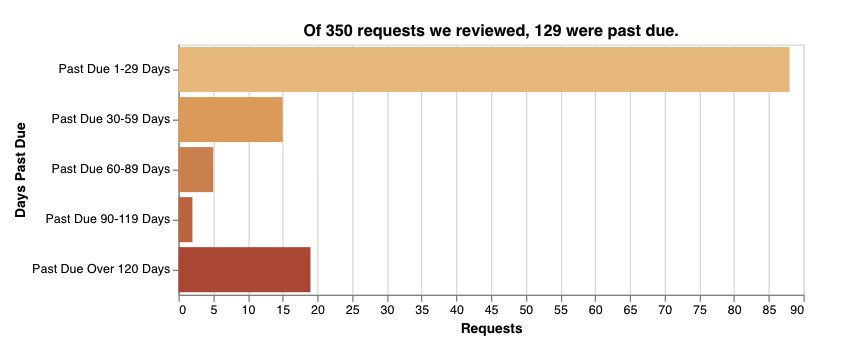
If an bureau doesn't reply to a request in the legally mandated time frame of 5 to ten business days, it then loses the ability to claim that a request is disproportionately burdensome, regardless of how long it would accept to complete the request. This places a potent requirement on the metropolis to respond on time. However, of the 350 requests I reviewed, effectually forty per centum were completed after the time limits allowed under land law, with twenty of those taking longer than 120 days to complete.
Information technology's unclear whether whatever agencies intentionally filibuster responses to FOIA requests every bit routine addiction, but an email from the Jones 24-hour interval email hack shows at least one asking where the City intentionally delayed responding . And concluding year, the Department of Law'south FOIA log showed that the City over again delayed its response until the last possible fourth dimension, noting to "wait to reply until due date."
CPD denied access to requesters looking either for rosters of CPD officers assigned to schools as school resources officers (SROs), or records related to a school's assigned SROs, arguing that releasing the records could endanger the lives of the officers assigned to a school. As with a bulk of CPD'south denials, information technology provided very little detail explaining how the release of the records could endanger the SROs.
In i denial, a requester was denied access to the misconduct records of police officers stationed at Hyde Park University simply because the asking "encompasses data related to the security measures put into place by CPD in conjunction with the Chicago Public School Organization to prevent also every bit respond to potential attacks upon the schoolhouse community population."
Merrick Wayne at Loevy and Loevy called the citations "sweeping and generic exemption claims" that give no factual basis about how releasing SRO names puts SROs, or anyone else, in any danger. He added that even if the records independent exempt information, CPD must still provide all other non-exempt information, which it did not do.
CPD additionally denied admission to data from forty-five requests for defendants in criminal trials, arguing that the release of the respective records "would conspicuously jeopardize the fairness of the ongoing criminal trial."
Despite its legal requirement to provide "clear and convincing prove," none of the xl-5 requests explain how the release of those records would jeopardize fairness as required by law, and only points to a department of the statute without any supporting information. In four of the denial letters we reviewed, the courtroom date mentioned in CPD's denial messages had already passed.
"CPD is merely reciting the statutory language, which Illinois courts routinely reject," Wayne said. "The response messages fail to explain how disclosure of whatsoever portion of any case incident report or even a person's own mugshot would create a substantial likelihood that a person would exist deprived of fairness at their trial or interfere with any proceedings. CPD's denials seem to imply that if CPD arrests a person, the only way to have a fair trial is to prevent that aforementioned person from accessing their own records."
It'south difficult to say whether CPD will proceed its patterns of non-transparency in the years to come. Frank Chapman, a customs organizer who was key in pushing for the Community Commission for Public Safe and Accountability, said he is cautiously optimistic.
"We're in a new set of circumstances," Chapman says. "CPD has an opportunity to act accordingly. They have an opportunity to proceeds trust with the community and the [Empowering Communities for Public Safety ordinance]."
Merely significant work is still needed to show that the Metropolis has a legitimate interest in being open and transparent. The extensive efforts needed to review their transparency practices are made much more hard by a lack of adequate tracking of data about how requests are handled, with very petty oversight or repercussions when consistent FOIA violations occur. To date, the Function of the Inspector General has yet to review any of the City's FOIA practices.
This reporting was supported by the Fund for Investigative Journalism .
✶ ✶ ✶ ✶
Matt Chapman is a freelance journalist in Chicago who focuses on issues of transparency and policing. He last wrote about a mayoral counselor whose contract skirted City hiring regulations .
Source: https://southsideweekly.com/cpd-routinely-denies-foia-requests-for-dubious-reasons/
0 Response to "Filing a Foia Lawsuit Agains the City of Chicago"
ارسال یک نظر